

Research report on safeguarding policies available

We are pleased to announce the publication of the first deliverable of the ESSEPA project: the Research Report on Safeguarding Policies. This document was developed within the European Sport Safeguarding Education and Promotion Action (ESSEPA) project, co-funded by the European Union.
As an initial step to strengthen safeguarding in university sport by developing an online education platform, this document provides an evidence-based foundation for the project's educational and policy-related deliverables. The newly published report is the result of desk research mapping the existing legal frameworks, safeguarding policies, and practices across the partner countries. The aim was to better understand national contexts and identify key gaps and variations. The findings are organized around two main areas of analysis: safeguarding in sport at national level, and safeguarding in university sport.
Key Findings
The research revealed considerable variation across partner countries in the extent to which safeguarding in sport is formally regulated and translated into practice. At the national level, some countries address safeguarding primarily through broader legal frameworks relating to general governance in sport, youth policy, or child protection. In other countries, explicit safeguarding-related measures are present through practical protocols, funding conditions, event-safety regulations, codes of conduct, or country-specific roadmaps.
Within university sport, the landscape is even more fragmented. In most countries, safeguarding is addressed through broader institutional frameworks, general violence-prevention measures, broader university procedures, disciplinary mechanisms, or ethics codes, rather than through an integrated safeguarding model. Common gaps identified across the countries include the absence of dedicated safeguarding policies, the lack of appointed safeguarding officers, and structured safeguarding education not being mandatory or systematically implemented. Furthermore, while competition settings are more often regulated, other relevant contexts like travel, overnight stays, and off-field situations are often only partly covered or not addressed at all.
Next Steps
These findings highlight the need for a safeguarding policy that can establish common minimum standards for participants in European university sport competitions, as they come from contexts with substantial differences in their safeguarding frameworks. To improve the current EUSA safeguarding framework, the report recommends establishing common minimum safeguarding standards, such as requiring all participants to complete safeguarding training and having each delegation appoint a safeguarding contact person. The results also support the development of a mandatory educational course to provide organizers, volunteers, officials, coaches, and athletes with a shared practical understanding of safeguarding.
Have Your Say
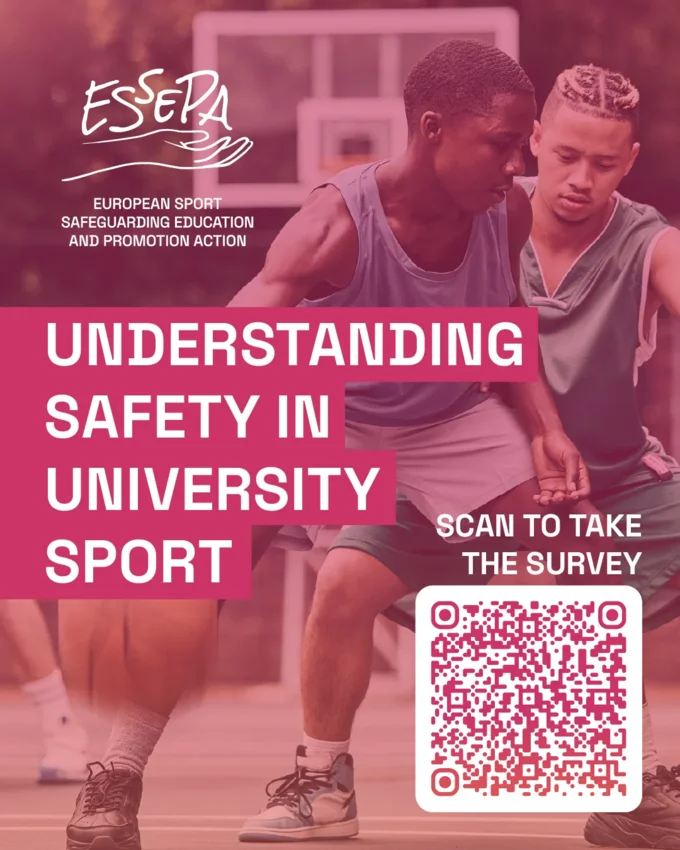
Following the release of this research report, our next deliverable will be the results of the survey analysis, which will be published at the end of June. The survey on safeguarding in university sport is still open for a few more days! We warmly invite all student-athletes, coaches, referees, event staff and university administrators to contribute their valuable perspectives before it closes. Your input is vital in helping us recognize daily realities and shape the future of safe sport environments across Europe.
To learn more about how our consortium is working to protect people and strengthen sport, we invite you to read the full Research Report on Safeguarding Policies, and also check our About ESSEPA page.
ESSEPA is co-funded by the European Union. Views and opinions expressed are however those of the author(s) only and do not necessarily reflect those of the European Union or the European Education and Culture Executive Agency (EACEA). Neither the European Union nor EACEA can be held responsible for them.